
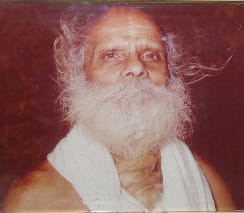
 Mahārājjī was born in West Bengal into a rich and pious brāhmaṇa family and despite being surrounded by material assets he always showed a sincere inclination towards spirituality. This brought him in his adolescent years to Vṛndāvana where he met the famous saint Śrī Rāmakṛṣṇa Dās Bābājī (Paṇḍit Bābā). Through Paṇḍit Bābā, Mahārājjī was introduced to the most erudite Vaiṣṇava of the times – Śrīla Vinoda Vihārī Gosvāmī – who became his Gurudeva.
Mahārājjī studied Vaiṣṇava philosophy and literature under him. Continuing to follow his Gurudeva’s instructions, he then went to Vārāṇasī to study other Indian philosophical systems. Having obtained 13 academic titles after 12 years of intensive studies, Mahārājjī returned to Vṛndāvana where he continued serving faithfully his Gurudeva.
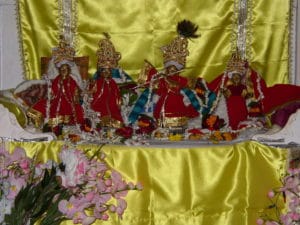
Mahārājjī’s āśram, Śrī Haridās Nivās, was constructed in 1965 at the place where Kṛṣṇa subdued the serpent Kāliya in Vṛndāvana on the banks of the Yamunā. When his Gurudeva left his body, Mahārājjī focused on the three types of service: sevā to Go, sevā to the scriptures, and worship of the deities Śrī Gaurāṅga Mahāprabhu, Śrī Gadādhar Paṇḍit Gosvāmī, Śrī Rādhā and Śrī Govindadev.
Mahārājjī fought against many adversities to give more impetus to the academic culture in Vṛndāvan. He established a library (Śrī Gaura-Gadādhara Granthāgaram), which today is one of the largest in all of Vraja-maṇḍala. He also set up a publishing center (Śrī Gadādhara-Gaurahari Press) to publish the scriptural texts, saving them from extinction. So far around 100 books have been published from the press, including recently also those in English, Spanish, Italian and Tamil.
Through the press, Mahārājjī wanted to send to the whole world the knowledge which the Supreme Lord in the form of Śrī Caitanya Mahāprabhu revealed to mankind, as this would benefit the entire human race regardless of caste, creed, religion or nationality.
 An important contribution of Mahārājjī’s was his commentary on the Brahma-Sūtras (or Vedānta-Sūtras) by Śrī Veda Vyāsa.
Traditionally, when an ācārya claims to be speaking of the Vedānta, the essence of all spiritual knowledge available to humanity, he writes a commentary on the Brahma-Sūtras to establish his point of view. However, when Mahāprabhu taught the supreme knowledge to mankind, he did not write any commentary on the Brahma-Sūtras.
 However, Mahārājjī felt that the original question asked of Śrī Baladeva Vidyābhūṣaṇ needed a more specific answer. How was Śrīmad-Bhāgavatam a commentary on the Brahma-Sūtras? By his mercy towards mankind, Mahārājjī clarified Mahāprabhu’s mind by showing how Śrīmad-Bhāgavatam explains the knowledge of Vedānta contained in each and every Brahma-Sūtra by writing the book “Vedānta-Darśanam Bhāgavata-Bhāṣyopetam” .
In this book he has listed all the Vedānta sūtras sequentially and for each one he has given the corresponding verse from Śrīmad-Bhāgavatam. He then explained the meaning in Hindi for the common man. Thus in the series of commentaries by different ācāryas there is this last commentary on the Brahma-Sūtras, the “Bhāgavata-Bhāṣya” by Śrī Haridās Śāstrī Mahārāj.
He who understands the teachings of Śrī Caitanya can easily appreciate that this great work negates the need for humanity to produce any other commentary on the Brahma-Sūtras in the future. After the publication of this work, Mahārājjī was given the title “vidyā-ratna” by the Vidvān Pracāriṇī Sabhā of Vārāṇasī.
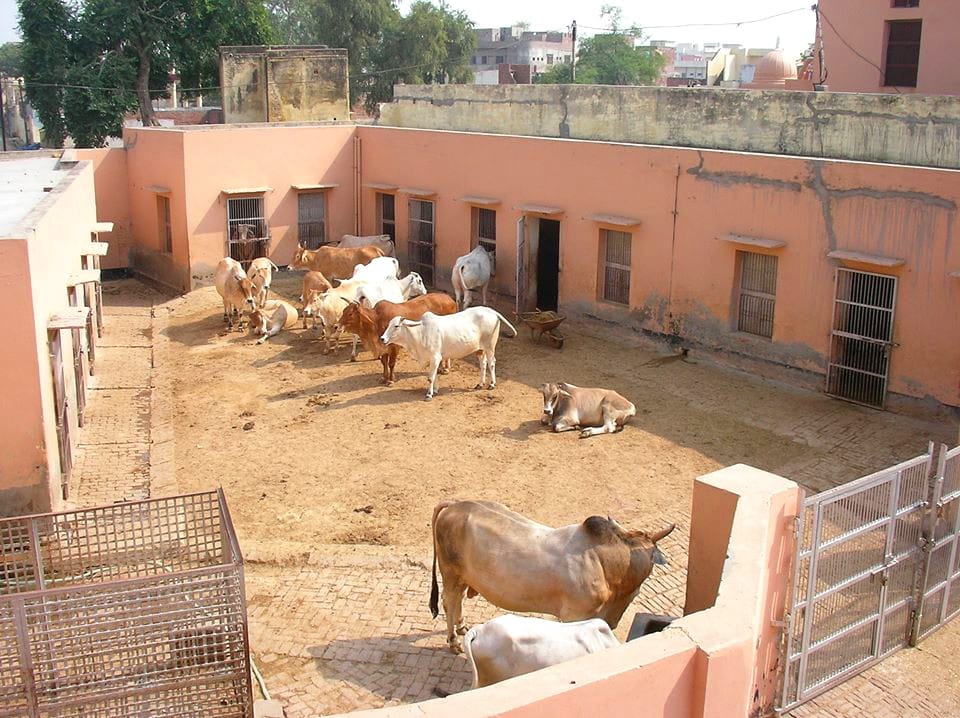 Another wish of Śrī Caitanya that Mahārājjī wanted to establish in Vṛndāvan was the original Vraja culture prevailing at the time of Śrī Kṛṣṇa. The culture of Vraja revolved around the sevā of Go, a special creation of the Supreme Lord Śrī Kṛṣṇa. Go in Sanskrit means the varieties of cows, bulls and calves that are native to India. (The imported varieties of cows and bulls and the hybrid varieties are called gavay and not Go. The glories of go-sevā are not associated with gavay). The Vedas, the Purāṇas, the Itihāsas and all other scriptures praise the Go.
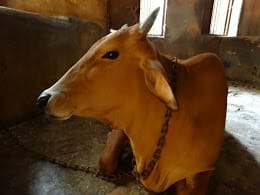 Mahārājjī felt that if the ideal practice of go-sevā is not preserved in society, the true sevā of God cannot come about. That is why he set a very high standard of absolutely selfless service to Go which is maintained in his āśram to this day: Go are considered to be members of the family without seeking any benefit from them. The milk is taken by the calves, and what they do not drink is milked so that Go Mothers are comfortable and do not get sick. Then the milk is offered to Kṛṣṇa and distributed among the inhabitants of the āśram.
The gośālās are well equipped and give Go all the necessary comfort. Every day they are offered laḍḍū or gur (types of sweets, depending on the season). In addition, of 200 Go about 40% are bulls. From the material point of view they are not of much use; however, in Śrī Haridās Nivās only their well-being is considered …
***
Mahārājjī always followed the path of Truth and dharma, and nothing in the world could dissuade him from it. Even towards the later part of his life, despite his advanced age, he continued to teach the scriptures, write books, ensure the proper sevā in the gośālā and āśram, and guide the spiritual seekers who would take refuge at his lotus feet.
(adapted from the material at uttama-bhakti y sriharidasniwas)